How Digital Marketing Works for Beginners: A Simple Guide
Digital marketing helps businesses find customers online. People use Google, social media, websites, and email every day. Businesses use these channels to reach them.
But how does digital marketing work?
The process is simple. A business finds its target audience. It reaches them online. It shares useful content. It builds trust. Then, it turns visitors into leads and customers.
Let’s understand how it works step by step.
What Is Digital Marketing?
Digital marketing means promoting a business online.
Businesses use many online channels for this. Some common channels are:
- Social media
- Websites
- Blogs
- Online ads
- YouTube
The main goal is to reach the right people.
For example, a local salon wants more customers. It can create a website. It can also use Google and Instagram to reach people who need salon services.
This is digital marketing.
How Does Digital Marketing Work?
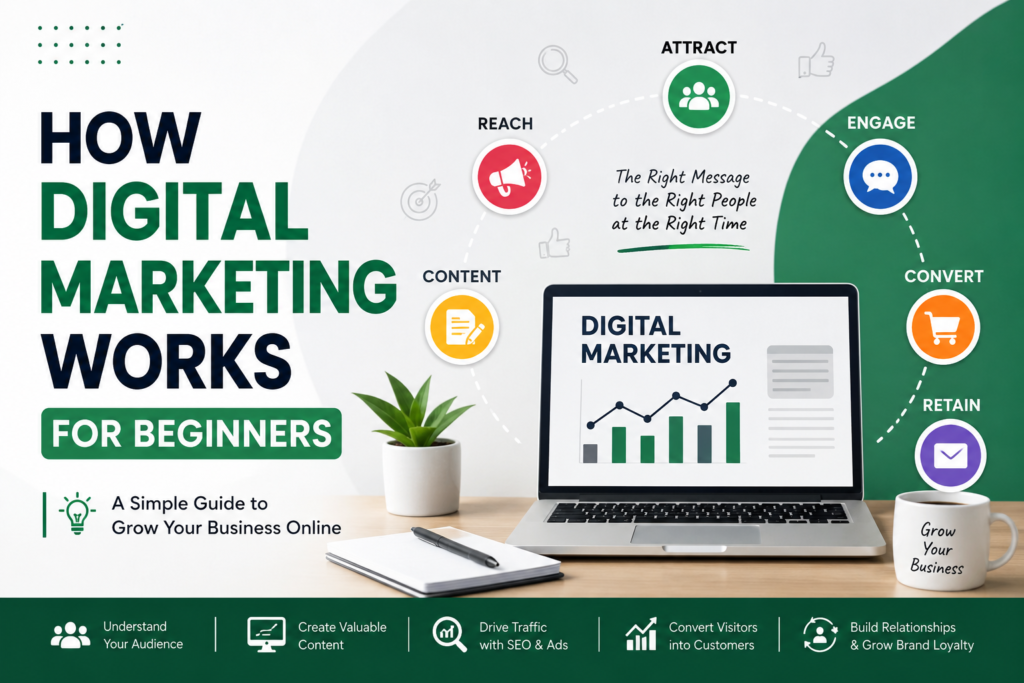
Digital marketing follows a simple process.
Find → Reach → Engage → Convert → Retain
Each step has a clear purpose.
1. Find Your Target Audience
First, a business needs to know who it wants to reach.
This group is called the target audience.
A business can look at:
- Age
- Location
- Interests
- Needs
- Problems
- Buying habits
For example, a fitness center may target people who want to lose weight or build muscle.
Knowing the target audience helps a business choose the right marketing channels.
2. Build an Online Presence
The next step is to build an online presence.
A website is often the main part of this presence. It tells people what the business does.
A good website should have:
- Clear information
- Simple navigation
- Contact details
- Service or product pages
- Clear buttons
- Customer reviews
A business can also create social media profiles.
These profiles help the business connect with more people.
3. Create Useful Content
People often search for information before they buy something.
This is where content helps.
A business can create:
- Blog posts
- Videos
- Social media posts
- Guides
- Images
- Case studies
- FAQs
For example, a digital marketing agency can write a blog about SEO for beginners.
Someone searching for SEO tips may find the blog on Google.
That person may then visit other pages on the website. They may learn about the agency’s services. They may also contact the agency.
Useful content can bring new visitors to a website.
4. Use SEO to Get Traffic From Google
SEO stands for Search Engine Optimization.
SEO helps a website appear in Google search results.
For example, a person may search for:
“Digital marketing agency near me.”
A business that uses SEO can try to rank for this search.
SEO includes many tasks.
These include:
- Finding useful keywords
- Writing helpful content
- Improving website pages
- Making the website faster
- Building quality links
- Making the site easy to use
SEO takes time. But it can bring free traffic from search engines.
5. Use Social Media
Social media is another key part of digital marketing.
Businesses use platforms like Instagram, Facebook, LinkedIn, and YouTube.
They share content to reach their audience.
For example, a clothing store can post videos of new clothes.
A restaurant can post food photos and videos.
A digital marketing agency can share simple marketing tips.
Social media helps businesses stay connected with their audience.
It can also help a business build trust.
6. Run Online Ads
Businesses can also use paid ads.
Google Ads and social media ads are common choices.
Ads can help a business reach people faster.
For example, a person searches Google for “best web design company.”
A web design company can show an ad for this search.
Social media ads work in a different way.
They can target people based on things like location, interests, and online behavior.
Businesses can set a daily or monthly budget for their ads.
Good ads can bring more traffic, leads, and sales.
But businesses need to track their ads. Poor ads can waste money.
7. Turn Visitors Into Leads
Getting website visitors is only one part of digital marketing.
The next goal is to turn visitors into leads.
A lead is a person who shows interest in a business.
For example, a visitor may:
- Fill out a form
- Call the business
- Send a WhatsApp message
- Book a meeting
- Request a quote
- Join an email list
A clear call to action can help.
For example:
“Get a Free Quote”
is better than a vague button like:
“Click Here.”
Make it easy for visitors to take the next step.
8. Turn Leads Into Customers
Not every lead will buy right away.
Some people need more information first.
A business can answer their questions. It can show reviews. It can share useful content. It can explain its services.
These steps help build trust.
For example, a person may contact a digital marketing agency but not hire it on the same day.
The agency can follow up and answer their questions.
When the person feels ready, they may become a customer.
9. Use Email Marketing
Email marketing helps businesses stay in touch with people.
Businesses can send emails about:
- New products
- Special offers
- Useful tips
- Company news
- Blog posts
- Events
For example, an online store can send an email about a new product.
It can also remind customers about products they left in their cart.
Email helps businesses build long-term relationships.
10. Track Your Results
Digital marketing gives businesses access to useful data.
You can track:
- Website visitors
- Leads
- Sales
- Ad clicks
- Search traffic
- Social media engagement
- Email results
This data shows what works and what does not.
For example, you run two ads.
Ad A brings 10 leads.
Ad B brings 30 leads.
You can study Ad B and use what worked in your next campaign.
This helps you improve your marketing.
Simple Example of Digital Marketing
Let’s take a local salon as an example.
First, the salon creates a website.
The website lists its services, prices, location, and contact details.
Next, the salon creates an Instagram page.
It posts photos and videos of its work.
The salon also uses SEO to rank for searches like:
“Salon near me.”
It can then run Google Ads to reach more local customers.
A person sees the salon on Google. They visit the website. They check the services and reviews.
Then, they click “Book an Appointment.”
The salon gets a new lead or customer.
After the visit, the salon can ask the customer for a review.
This can help attract more people in the future.
This is how different parts of digital marketing work together.
Why Is Digital Marketing Important?
Digital marketing helps businesses reach people where they spend time.
It can help a business:
- Get more website traffic
- Reach new customers
- Build brand awareness
- Generate leads
- Increase sales
- Build trust
- Stay connected with customers
It also lets businesses measure their results.
This makes it easier to find what works.
Then use AI tools like ChatGPT to improve your work.
Final Thoughts
Digital marketing is not as hard as it may seem.
The basic process is simple.
First, find your target audience.
Then, reach them through the right online channels.
Create useful content. Use SEO to get found on Google. Use social media to connect with people. Use paid ads when you need faster reach.
Then, turn visitors into leads and customers.
Finally, track your results and improve your strategy.
You do not need to use every digital marketing channel at once.
Start with the channels that fit your business. Learn the basics. Test different ideas. Track your results.
With time, you can build a strong digital marketing strategy that helps your business grow.
For more information check our other post Blog page.
